
Every chemical and food-grade shipper’s transportation needs look a little different.
Some companies want one trusted logistics partner to manage most or all of their bulk freight. Others already have strong carrier relationships but need backup capacity, emergency support, or help with difficult lanes. Still others want to outsource the day-to-day demands of transportation management so their internal teams can focus on production, customer service, and growth.
That flexibility is one of the biggest advantages of working with a bulk freight 3PL.
Bulk liquid and dry bulk shipping requires more than simply finding a truck and tanker or trailer. It involves specialized equipment, carrier vetting, compliance knowledge, tank wash documentation, product compatibility knowledge, and management of each load. For chemical, food-grade, and other bulk shippers, every detail can have a big impact on cost, service, safety, and product integrity.
Depending on your needs, a bulk freight 3PL like Bulk Connection can support your transportation program in three primary ways.
1. Core Transportation Partner
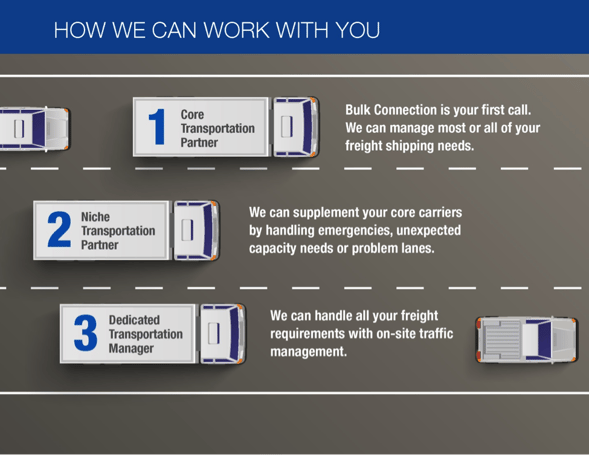 For some shippers, Bulk Connection serves as the first call for most or all bulk freight shipping needs.
In this role, Bulk Connection acts as a central transportation partner, helping manage liquid bulk freight and dry bulk freight across a wide range of lanes, products, and service requirements. Instead of maintaining multiple carrier relationships, shippers can lean on one trusted bulk transportation team.
This type of relationship can be especially valuable for companies that:
- Ship liquid or dry bulk products regularly
- Need access to a broader carrier network
- Want more consistency in communication and execution
- Move freight across multiple regions
- Require specialized equipment or documentation
- Want to reduce the internal workload of carrier sourcing and traffic coordination
As a core transportation partner, Bulk Connection manages key details from start to finish. That includes sourcing (and vetting) qualified carriers, coordinating schedules, confirming key shipment requirements, communicating with facilities and drivers, and helping freight move as smoothly as possible.
2. As-Needed Transportation Partner
Not every shipper needs a 3PL to handle every load.
Many companies already have established carrier relationships in certain lanes. Those relationships may work well most of the time. But even strong transportation programs can run into gaps.
A core carrier may not have capacity when demand spikes, or it may not serve a new lane that you have. A shipment may require a trailer type or certification that falls outside your normal carrier base. Weather, labor issues, production changes, and other disruptions can all create transportation challenges that fall outside the routine.
That is where Bulk Connection can serve as a niche transportation partner.
In this role, Bulk Connection supplements your existing carrier base rather than replacing it. You continue working with your core carriers where those relationships make sense, while using Bulk Connection for the lanes, situations, and freight challenges that require additional support.
This can include:
- Emergency bulk freight coverage
- Unexpected capacity needs
- Problem lanes
- New lanes or new customer locations
- Seasonal volume spikes
- Specialized liquid or dry bulk equipment
- Backup capacity during rail, barge, or carrier disruptions
- Help when a regular carrier cannot meet a shipment requirement
This type of 3PL relationship can also be a low-risk way to test new freight strategies. If you are exploring new lanes, adding customers, expanding into new regions, or dealing with a product that requires special handling, Bulk Connection can help you evaluate transportation options before making a larger commitment.
3. Dedicated Transportation Manager
For shippers that want more hands-on support, Bulk Connection can also serve in a managed transportation role.
Managing bulk freight internally takes time. Someone has to source carriers, confirm equipment, schedule pickups and deliveries, monitor shipment status, communicate with facilities, maintain carrier information, address problems, and keep stakeholders informed. When shipments involve regulated products, strict appointment windows, or specialized equipment, the workload becomes even more demanding.
In this managed transportation role, Bulk Connection acts as a true extension of your business, handling all of your bulk transportation needs on your behalf. This allows you to focus on your core operations while we use our expertise and large nationwide carrier network to move your freight in an efficient and cost-effective manner.
This kind of support may include:
- Carrier sourcing and qualification
- Load scheduling and coordination
- Communication with drivers as well as loading and unloading facilities
- Shipment tracking and updates
- Documentation support
- Issue resolution
- Capacity planning
- Support for recurring or high-volume freight needs
- In-person support with Bulk Connection staff at your facility if needs dictate
For growing companies, this can be an efficient alternative to building a larger internal traffic department. For established shippers, it can provide extra bandwidth and specialized knowledge during busy periods, network changes, or operational transitions.
Choosing the Right Relationship for Your Freight
The right 3PL relationship depends on your transportation program, your internal resources, and the types of challenges you face.
If you want a trusted partner to handle most or all of your bulk freight, a core transportation partnership may be the best fit.
If you already have strong carrier relationships but need backup capacity, emergency support, or help with challenging shipping lanes, a niche transportation partnership may make more sense.
Or, if your team needs help managing the day-to-day details of freight coordination, a dedicated transportation manager approach can provide the added support and expertise you need.
Of course, the relationship with your bulk freight partner can evolve over time. You may start by using Bulk Connection for a few problem lanes, then expand the partnership as trust builds. The flexibility of the 3PL model allows the relationship to match your needs instead of forcing your freight program into a rigid structure.
To learn more about the many ways that Bulk Connection can support your supply chain operations, contact us today.